

Between performance, risk and hope for a better year
After four years marked by drought and uncertainty, Romanian farmers are looking cautiously and optimistically towards the new agricultural year. The rains of recent months, well-established crops and investments in technology send signals that agriculture can regain its balance – with one essential condition: predictability.
In the yard of a family farm in Ulmu, Calarasi County, the machines are not just equipment, but true work partners. From high-capacity telescopic arm loaders to assumed agronomic decisions, every detail matters.
Machinery, the natural extension of farm work
Choosing a high-performance telescopic arm loader is no longer just about power, but about adapting to the current pace of the farm. The new model that has entered operation offers a lifting capacity of up to 4,200 kg at a height of 7 meters – a configuration considered optimal for current agricultural work: handling fertilizers, stacking production or fast transport to the farm.
The difference is felt in the details: increased travel speed, quick hydraulic controls, load stability and safety systems that reduce the risk of rollover. Basically, operations that previously required more time are now carried out at a fast pace, with considerably less effort for the operator.
Higher, stronger, faster
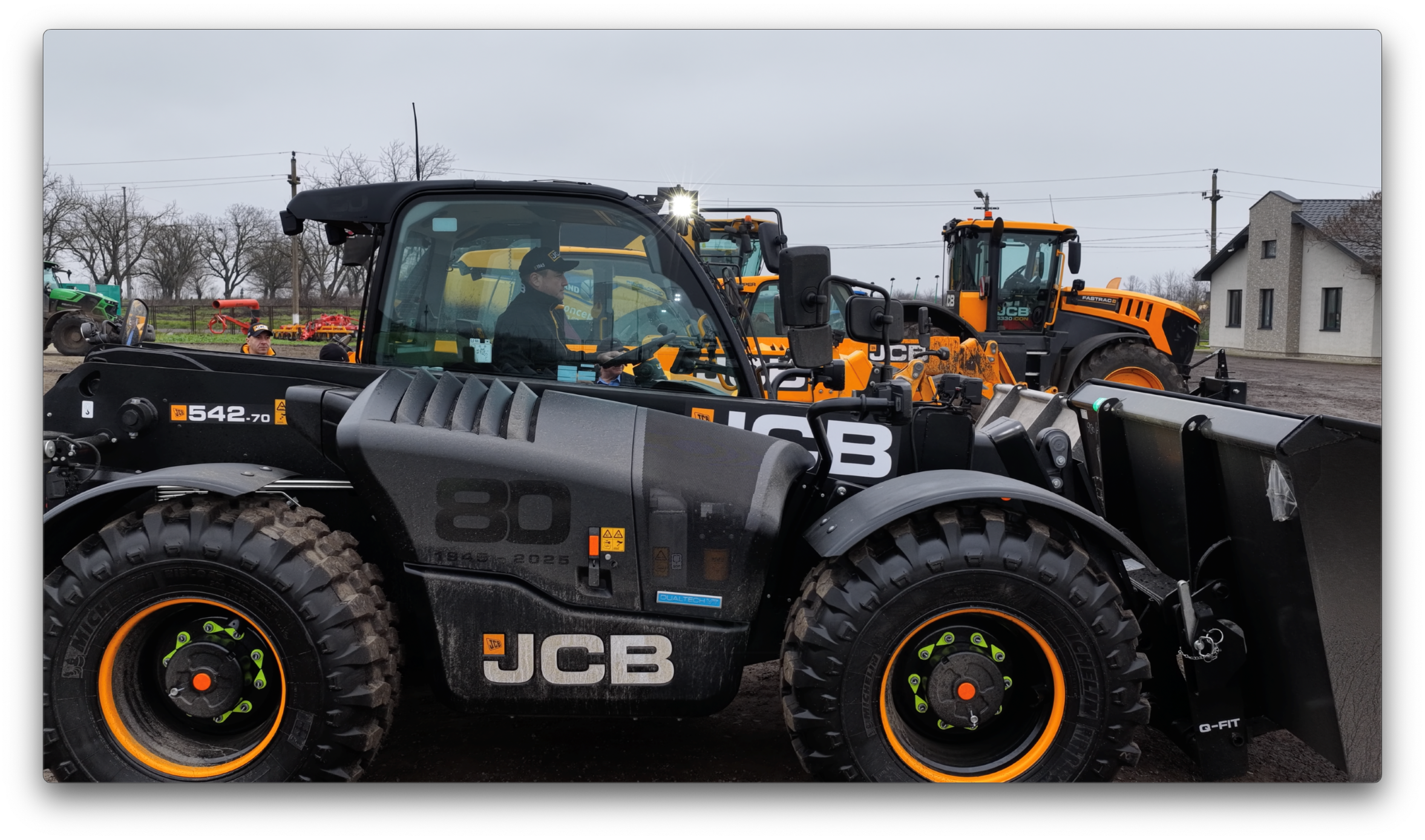
Why the Negoiță family chose the JCB anniversary edition – 80 years
Founded in 1945 by a farmer, JCB has grown to meet the needs of those in the field. The 80th anniversary edition is the expression of this philosophy.
In the farm of the Negoiță family in Ulmu, Calarasi County, the JCB 542-70 model, JCB anniversary edition – 80 years, arrived just before the holidays. It is a telescopic arm loader from the Agri Pro range, equipped with a 173 hp engine and DualTech VT transmission.
This transmission combines two technologies: Powershift – renowned for its robustness and transport efficiency – and the continuously variable transmission (Vario), which is extremely precise when working at low speeds, specific to daily handling on the farm.
The choice comes naturally, amid the development of the family business: from 109 hp machines, to 145 hp Agri Extra variants, to this anniversary model, more powerful and faster. The new loader is used both in the field and on the farm – for fertilizing, sowing, transporting and stacking production – being purchased to replace older machinery, still functional, but outdated by the current pace of work.
“We want something better, bigger and stronger,” explains farmer Laurențiu Negoiță, stressing that the JCB anniversary edition is not only a symbol of the company’s 80 years of existence, but a concrete tool that responds to the need for speed, capacity and efficiency in a modern farm.
Does technology keep up with farmers’ demands?
Farmers are demanding more and more from their machinery: to lift more, higher and faster, without compromising safety. The answer comes from Valentin Cojocaru, NHR Agropartners representative, who explains how JCB telescopic arm loaders are designed exactly for this type of request.
“In our range of JCB loaders, working heights start from 6 metres and reach up to 10 metres, covering most agricultural operations. In this case, the 542-70 lifts 4,200 kg up to 7 meters – an extremely commonly used height and sufficient for daily farm work.”
The difference is not only in the numbers, but in the way the machine actually works. The Flex Speed function allows for high engine speeds and high hydraulic flow, while driving at low, controlled speeds. The DualTech VT transmission separates the working speed of the boom from the travel speed, providing precision and speed in loading and unloading.
Everything is supported by the Smart Hydraulic system, which uses hydraulics when lifting and gravitational force when descending, achieving an optimal balance between power and control.
Safety at height
A natural question arises when we talk about large loads lifted to considerable heights: stability.
JCB’s experience has led to the development of a patented load monitoring system. The machine is equipped with sensors that continuously check the position of the boom and the weight of the load. When approaching the stability limit, the system alerts the operator and can stop certain movements – without completely locking the machine.
“The arm no longer extends, you withdraw it and continue moving. There is no need to restart the work cycle”, explains Valentin Cojocaru.
The JCB Anniversary Edition also comes with a high level of equipment: hard tyres, limited-slip differentials, a full package of LED lights – including on the arm – and additional hydraulic connections for transport, including with trailers equipped with ABS.
The cab completes the image of a machine designed for long work cycles: seat with air suspension and heating, excellent visibility, radio and a premium working environment. The boom suspension ensures better material retention in the bucket, reducing transport losses.
A less visible but essential advantage is the cup clamping system. “The JCB grip is very wide, which allows for lighter buckets and a greater amount of useful material transported. Basically, we transport in nine buckets as full as others in ten”, explains the NHR Agropartners specialist.
Oilseed crops, the winners of the year
From an economic point of view, the recently ended agricultural year favored oilseed crops. Rapeseed and sunflower brought the best results, both in terms of production and price stability, compared to cereals. For large farms of more than 2,000 hectares, these remain viable solutions, while niche crops involve additional risks and resources.
Agriculture, between technology and responsibility
The experience of recent years has shown that technology can compensate for many of the shortcomings, but it cannot replace them all. Irrigation covers only part of the surfaces, and the rest remains to the hands of the weather.
“God is the most important agronomist,” says Anamaria Damian, director of NHR Agropartners, stressing that, beyond plans and investments, agriculture depends decisively on the climate.
In this context, farmer Florin Negoiță’s wishes for 2026 are simple, but profound: health, peace and predictability. A year in which weather, prices and technology work together, not against the farmer.